Category: Uncategorized

  • Rainy Day

    Rainy Day

    Science Fiction and the Repairing of the World

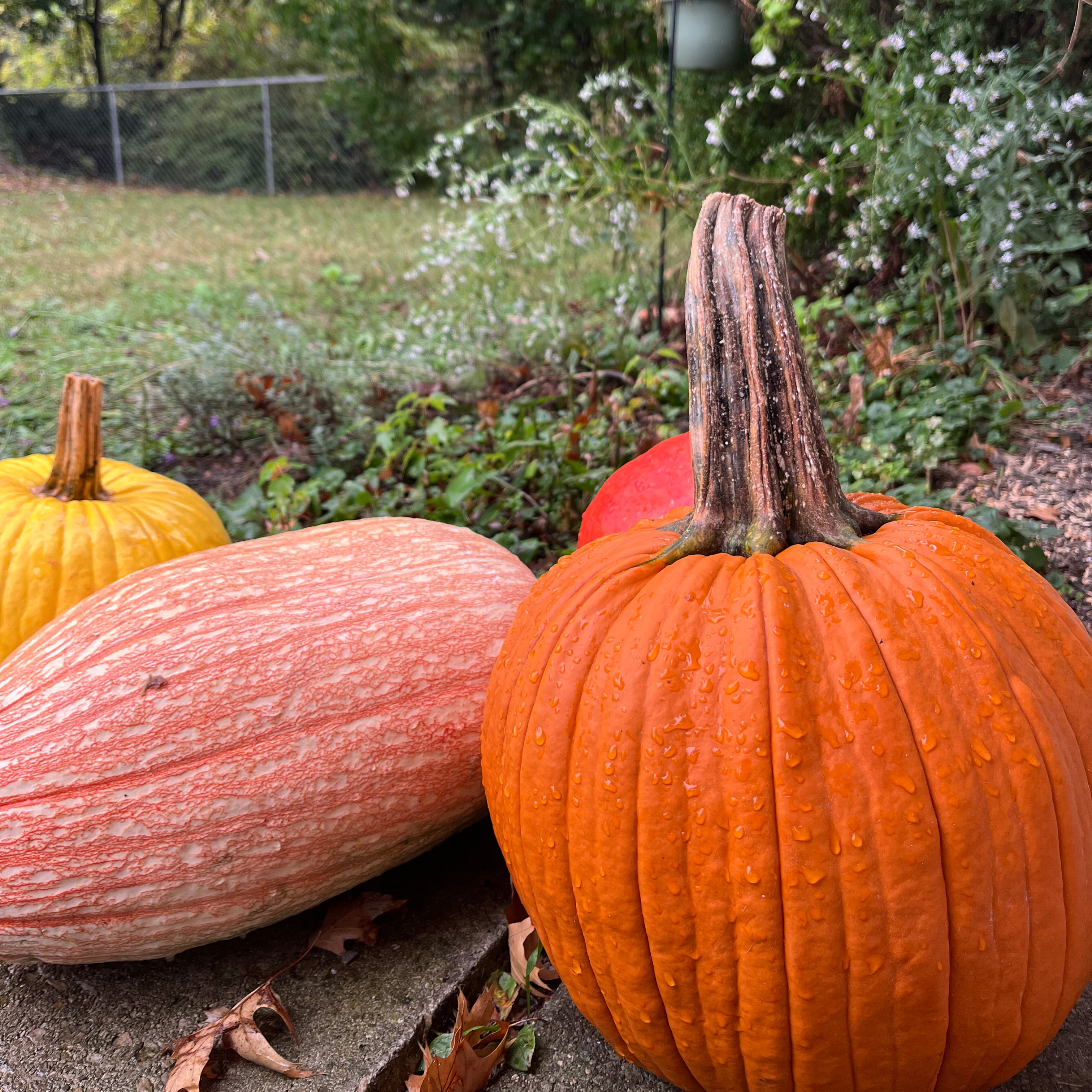
    three pumpkins in different shades of orange

    This afternoon I took a break from a busy day to sit still and listen to the rain. I made a cup of coffee, and took it out to the porch to watch the rain that has been falling since last night. I left my phone on the desk, along my ordinary worries and my existential angst, and went out to listen to the rain.

    I heard the thirsty ground drinking in every morsel of this gentle rain, and sighing in relief that the long drought has come to an end. I heard the intermittent stream beyond the fence gurgling happily again, dried mud loosening into a soft landing for the eggs of frogs and mosquitoes alike. I heard the birds flitting around in the low cover of the honeysuckle bush, finding bugs to eat despite the wetness of the day. And as I sat there, I found myself thinking about the what the world might become if all its wounds could be healed as easily as this soaking rain feeds the land…

    Read more on Substack

  • Grounding

    Grounding

    Thoughts on the gentle hug of gravity

    My days have been so busy that the only time to write is early in the morning, a time when my mind is still fresh and the dreams of the previous night still feel present, like the lingering scent of rain on a clear morning. Fall has crept in almost overnight, with cooler weather and shorter days. The leaves of the walnut trees are starting to turn their bright shade of yellow as their heavy fruit falls to the ground with a thunk. It is also a time when the earth feels softer, or I feel softer, maybe both. In the evenings lately I sit outside to watch the sunset bundled up in a sweatshirt. The swifts have departed for South America and so it’s only the bats fluttering about above the trees at dusk now. The crickets continue their chant, adding to the beauty of the evening.

    Read more on Substack

  • Longest Night

    Longest Night

    The comfort of darkness in the midst of grief

    Yesterday was the shortest day of the year in the northern hemisphere, the day when our part of the earth is tilted the farthest away from the sun. It is a time to both acknowledge the power of the creative darkness as winter takes hold, and to recognize that the light will return, as it does each year, in its own time. The long nights are feeling particularly quiet this year because we recently had to say goodbye to our beloved dog and family member Lucky…

    Read more on Substack

  • Awe

    Finding Strength for the Journey

    Preached at Willow Avenue Mennonite Church, Clovis, CA on November 16, 2025

    Text: Revelation 22: 1-2

    On Thursday morning of this week, I woke up to a Facebook feed full of gorgeous brightly colored photos of the aurora from friends all over the country. It was a welcome break from the righteous anger at our current government and lament over hungry neighbors and suffering in Gaza. These things are important, but we also need awe to remind us that we really are small in the grand scheme of the universe. Awe is like a glimpse of heaven present in the here and now, a reminder that this mess we’re in now is not the end, and is not even the biggest thing happening in the universe, though it feels overwhelming to us.

    Awe, an often-overlooked emotion in psychology, is having something of a cultural moment right now. A quick google search turned up 10 books with ‘awe’ in the title published in the last five years. One reason for this could be that awe is the ultimate antidote for fear and cynicism, two emotions running rampant in our world ravaged by the continuous wildfires and floods of climate change and the tumultuous political reality currently gripping the US with global effects. Awe invites us into a different kind of reality, immediately present and awake to the vast beauty of the world, even in the midst of tragedy.

    Awe doesn’t need epic panoramic views or exotic locations, though those are great places to experience it. Awe is about paying attention to the phenomena of everyday reality—the smell of crushed pine needles underfoot, the beauty of an early winter sunset, the sound of crickets at dusk. Awe is all about paying attention, the moments we choose to focus on.

    And what better example than this week’s auroras, which were visible as far south as Alabama and Florida. After failing to see them in the city on Tuesday night, we drove out to the country Wednesday night to try to see the fantastic display, worried that we had missed out. We pulled into the nature center of a state park, bundled up in coats and hats, and stood in a dark field, waiting for our eyes to adjust. At first, I thought we’d missed it. I watched the dark sky for any sign of color. And then suddenly, a pulse of deep pink sprung up between two trees, low on the horizon. Soon there was even more color, red and green lighting up the whole northern sky. We both gasped. It was breathtaking, like a miracle light show playing out in silence above us. We managed to take a few photos that captured even more light than we could see with our own eyes. We drove home in the dark, along country roads, feeling elated despite the lateness of the hour.

    Awe is powerful medicine. It gives us a more holistic vision of reality, a reminder of our smallness in a vast universe which is profoundly comforting. It’s also a reminder that this moment of suffering won’t last forever. And it is these same characteristics that we find in the vision of the new earth in these last verses of Revelation.

    It’s always hard to talk about hope in the midst of crisis and chaos. I suspect that every generation on earth has felt they might be living in the end times at some point. There is no doubt that at least in the United States, we are enduring a time of large-scale social and political upheaval. And all of this feels really heavy. It’s hard to get up the courage to read or listen to the news each day, because there’s this ominous feeling that nothing good is happening.

    And the book of Revelation was written in a similar time of turmoil. Christians were facing pressure to assimilate to the culture of the Roman Empire and abandon their egalitarian and non-violent ideals in favor of nationalism and imperialism. John fights back against these pressures with a creative prophetic imagination, that for all its bizarre visions and symbols, asserts that God is in control and that even though evil appears to be winning, it is God who will be triumphant in the end.

    The passage we read this morning comes at the very end of the story arc, the happy-ever-after moment when God comes down to dwell on the earth. It is this vision of a restored earth that the early Christians looked to in times of persecution and threat, when they feared the world had lost its way. And today we look towards this same vision in hope that there will be a time beyond all of this turmoil.

    It’s important to note here that hope and optimism aren’t the same thing. Hope has a more eschatological tone to it. Hope is an orientation of the spirit that persists even when we do not feel at all optimistic about the future. Hope is one of the core tenets of our faith, acting as Jesus acted because it’s the right thing to do instead of because we think it will be successful in our lifetime.

    One of the places I experience hope and awe is through science fiction. One of the beautiful things about science fiction is that it gives the author the power to imagine what the world might be. Futuristic literature isn’t always rosy. Sometimes the worlds are depicted as dangerous and fallen from any form of stability and justice. But other authors have chosen to set their stories in worlds they want to see come into being.

    One such author is Becky Chambers, creator of the Monk and Robot series and the Long Way to a Small, Angry Planet series. If you haven’t already heard of her, Becky Chambers creates beautiful, complicated worlds in which her stories take place. In her Long Way to a Small, Angry Planet series, she introduces the reader to a universe in which humans aren’t the only sentient beings. In fact, humans have very little clout among the more advanced alien species because we ruined our planet and even now have difficulty getting along with our fellow humans. Humans, far from being the center of the universe, are just one small group among many in the Galactic Commons, a federation of species that have been traveling the universe much longer than humans. It is a reminder that though we often think of ourselves as the only beings in the universe, just as people once thought the sun revolved around the earth, we are only one small, unimportant part of the tapestry of cosmic creation.

    In the Monk and Robot series, the main character Dex, leaves their comfortable life in a monastery in search of the song of crickets, which are absent in the city where they live. The whole first story is a quest to find awe in the form of crickets. The series as a whole is set on a planet called Panga, where humans have survived what they call the Factory Age and successfully weaned themselves off oil to live in cooperation with the natural world. In this new era, everyone has what they need to thrive. No one hoards wealth, and no one goes hungry. Life isn’t perfect for sure, and humans are still searching for meaning, as the quest of the main character shows, but there is no more capitalism and the extreme inequality that comes with it.

    These worlds are a glimpse of what could be, a vision of a new heaven and a new earth. A city with a tree that bears all kinds of fruit, a tree of healing for all nations, and a clean river running through the middle of it, sustaining all of life. We have a long way to go, but these visions, these experiences of awe, propel us forward on the journey.

    A few more words in closing about awe.

    In an age where we tend to favor cynicism over hope and are constantly bombarded with bad news because that is what gets us to keep clicking, keep reading, keep buying, awe is transformative. It is a powerful force for waking up, for breaking out of this cycle. Awe allows us space to rest up, to restore our souls. Awe gives us strength to keep working for good even when we don’t see any immediate results because we have had a vision of what could be.

    So today I invite you to go out into the world in search of awe, in the exuberance of a child watching leaves fall, in the twinkling of stars in a dark late autumn sky, in the gentle gurgle of a stream, or the quiet depth of a fast-moving river. There is much work to be done, much strength to gather for the road ahead of us.

  • Shifting Grounds and the Good Story

    Sermon preached at City Peace Church, Cincinnati, OH on March 17, 2024

    Scripture text: Mark 8:31-37, First Nations Version

    I love the words of this passage in the First Nations Version of the scripture this morning. This is a well-known text, and hearing it in a different voice gives new meaning to some of these oft-repeated phrases. I particularly love the reframing of eternal life as “the good story.”

    “Those who seek to save their lives will lose it. Those who lose their lives, more my sake, will inherit eternal life.” We usually think of this text as a call to sacrifice ourselves, to die a valiant death like the early Anabaptist martyrs or the Roman Christians. But, losing your life isn’t usually literal in the way of martyrs and freedom fighters. It’s often more subtle than that—restructuring your life around caring for others, around advocating for the marginalized, around the reality of a warming planet. What does it mean to lose your life for Christ, to reorient towards eternal life—the kin-dom of God—the perpetuation and thriving of life on this planet, far beyond my own life span?

    First, losing your life—for Christ, for others, for the earth—is a countercultural notion. Our modern western society privileges individual choice, autonomy, and freedom. While this is noble in theory, in practice this is comes at the expense of the wellbeing of the human community and the earth itself. Being able to make your own choices about where to live, whether or who to marry, what kind of work to pursue, these are all good and important things. Don’t get me wrong. But at some point we got lost and started valuing our autonomy more than we value the wellbeing of all life. Walking in the way of Jesus, losing your life, means orienting your life towards God, towards others, towards life as a whole instead of your own individual wants and desires.

    And let’s also be clear right up front about what losing your life isn’t, because there are a lot of destructive interpretations of this text, often aimed at women and those in caregiving roles. Losing your life for Christ does not mean sacrificing yourself by staying in an abusive relationship. It also doesn’t mean pursuing work that you hate out of a feeling of obligation or coercion. Walking in the way of Jesus is so much more than that. God doesn’t want you to stay in an abusive relationship or always put others first to the detriment of your own wellbeing. This isn’t the kind of life that Jesus calls us to.

    So what does eternal life, the kin-dom of God, look like? What does it mean to live into the good story? Most importantly, it means embracing change. All of us are changing all of the time. We live in a rapidly changing climate, in a changing human culture. Nothing stays the same for very long. But many of us are perpetually and incredibly resistant to change. We want things to stay the same, if things are going well for us, and are resentful of any kind of disturbance to our comfortable lives. I count myself in this, by the way. And there are many things that are worth preserving, family traditions, memory, our faith commitments. But none of these are entirely immune to change.

    The truth is that we all lose our lives eventually. We only get to walk this earth for a certain length of time, and Lent is a season when we remember this, that we come from and return to the soil. Lent is also a time when we remember that Jesus’s time on earth with us was brief. He certainly made the most of it, healing and teaching about the coming transformation of the world. If we learn anything from Jesus’s ministry, it’s that clinging to the status quo only leads to death, and you’re liable to have your table turned over in the temple by a prophet in righteous indignation.

    We all lose what we have eventually. But willingly giving it up for another—that is really being alive. Being involved in work that builds solidarity with the poorest and most vulnerable members of our society, advocating for justice, reaching outside our comfort zone to become more deeply who we are and to take part in something communal and holy—that is what it really means to live out our faith. And it begins with letting go of our resistance to change, to losing our lives in small ways each day.

    In the natural world change and adaptation are the basis for the vast diversity of life around us—animals, plants and other organisms make the most of their particular environment, learning, growing, changing as the ecosystem they are part of changes. There’s nothing inherently scary about change. It’s just that we get so used to the way things are that we resist any attempt at adaptation, even when we are suffering.

    In this context losing your life to be part of the good story can be a positive thing. Learning to live as part of your watershed, part of your community (both human and beyond-human). Learning to live for others, to be part of a global movement of peaceful transformation. Love has an inherently self-sacrificial quality to it, in that your life isn’t all that matters. Like a parent who loves a child, or a spouse, and is willing to give up everything for their safety, for their happiness. This is unhealthy when it is one-sided, but mutual love is mutually self-sacrificing, and becomes part of something larger. And also, God is with us always, through every change, every upheaval, every adaptation.

    I have had a front row seat in the power and peril of change. Some of you know that I have a connective tissue disorder that causes nearly constant neurological changes in my body. I have times when I am very able—walking and thinking clearly—but there are other times when my legs are weak and I use a walker or a wheelchair. I also experience times when it’s very difficult to concentrate or be productive, and all I can do is rest in my own fragile embodiment and wait.

    It took me a long time to make peace with my changing body, and I still have moments of frustration, but when I was able to love myself, it also became easier to love others, to appreciate the great amount of pain that exists in the world and do something to mitigate it. I feel deeply that change is a river we are all swept up in. You can either swim vigorously against the current, wearing yourself out, or you can learn to float with the flow of the current, paddling a little here and there to avoid the boulders, but not fighting where the river is taking you.

    Losing my life has been all about learning to navigate this river of change. We all want things to stay the same. We want to keep our comfortable large houses and drive in our peaceful cars and retain our habits of consumption. If we are from middle-class families, we want the same things our parents had. But those things aren’t necessarily life-giving, and they can come at the expense of the health and wellbeing of other people as well as the natural world. Pause. If you’re getting nervous, this is not leading to a call to give up all of these things and live off the grid. That’s not what I am advocating, though Jesus did command his disciples to give all they had to the poor in order to follow him.

    What I am trying to say is that when we orient our lives around material comfort, it too easily slips out of our grasp and becomes something life-destroying. When we live for something greater, when we orient our lives around fostering the kin-dom of God, around being part of the good story, something deep inside of us shifts and wakes up. The job, the car, the house—those things become less important than other more life-sustaining activities.

    When I think of this, what comes to mind is a scene from the movie Harriet that came out a few years ago about the life of Harriet Tubman, a former slave and conductor on the Underground Railroad. There is a moment when she is meeting with other conductors and backers after the passage of the Fugitive Slave Act, which made their work more dangerous. She gives an impromptu speech to those gathered saying that she would give every last drop of blood in her body to rescue as many people as possible, despite the worsening peril of doing so. She was vibrantly alive in that moment, clear in her purpose and her incredible power.

    What is it you are willing to give every last drop of your blood for? I would easily give my life for my family—my partner, my nieces, my brother, my parents. But I’m not sure what else. And while this may be an interesting thought experiment, as I said before, losing your life doesn’t necessarily mean death. We all seek to save our lives or lose them on a regular basis, which each choice that we make.

    What might it look life to live for something more than ourselves, our families, or our own security and comfort? This will mean different things for different people. Some do indeed follow Jesus in giving all they have to the poor and dedicating their lives to service. But we can’t all be monks or nuns or hermits living off the grid. Living for others means making decisions based on what is most beneficial for our fellow humans and for the created world. It means sharing from the bounty of our lives instead of hoarding it for an imagined apocalyptic future. Love itself has an inherently self-sacrificial quality to it. Once your love someone, your life becomes bigger. You’re no longer all that matters.

    If you’re not sure where to start, look around in your own neighborhood. This is what Jadav Payeng did. Payeng is a 64-year-old indigenous man living in northeast India who has planted a forest of over 1,300 acres on a formerly barren sandbar along the Brahmaputra River. When he was 19 he was walking in the area and came across a large amount of snakes who had died in the heat from a lack of shade. He started by planting 30 bamboo seedlings so they would have a place to shelter in hot weather. He tended the plants as they grew and began to plant trees of many different species. Over the course of his life, the forest has grown into a refuge for tigers, elephants, rhinos, monkeys, birds and more. And he did all of this while working as a dairy farmer raising cattle and buffalo. This forest is now an island the size of Martha’s Vineyard with hundreds of thousands of trees, planted and cared for by one farmer who was also raising his own family and living his life.

    So my question for you this morning is, what will you begin that will outlive you? What seed will you plant, that will take a hundred years to mature when your body has long returned to the earth? The world needs people who can think beyond the course of their own lives and to remember that they are part of a very old story. This story began long before we came into existence, and will continue far after we die. How will you be a part of it in this changing world?

  • Living Water Pulses Through Us

    Sermon preached at Columbus Mennonite Church, Columbus, OH on March 12, 2023

    Scripture text: John 4:1-42

    I want to share some stories this morning about water, holy places, and how living water helps us find a home in the world. Water makes up over half of the substance of your body, and three-quarters of your brain is water. Water literally is life, as the saying goes. When Jesus arrives at the well in the middle of the day, he is likely just as thirsty as the next human, parched from the brilliance of the desert sun. But what he eventually offers the Samaritan woman is something quite different, the living water of the kin-dom of God.

    This passage from John is a powerful one, getting to the heart of what it means to follow Jesus and to be nourished by living water. It is the longest theological conversation Jesus has with anyone in the gospels, and it is with an unwed Samaritan woman, the ultimate outsider. But I have to start by saying, this story makes me feel uneasy. Part of it is the way Jesus comes off, at least in English. “Give me a drink” does not sound very polite. And he shouldn’t even be talking to a woman in this time and place. Then there’s the bit about the husbands. Five of them, yikes, and living with a man who is not her husband. It makes her sound like an unscrupulous woman. The reality, though, is likely more complicated. There are a lot of reasons why she could have had five husbands. She could have been a widower, since men were more likely to die than women, in battle or from old age if she was wed to an older man. She could have been divorced, since men could divorce their wives but not the other way around. And she was likely living with a man she was not married to in order to survive in a world where women had virtually no rights if she no longer had any male relatives. This puts her squarely in the position of outsider even in her own community.

    And, her past relationships aren’t the point. Jesus does not seem at all concerned with her many husbands. Nowhere in the passage does he tell her not to sin, as he does in other encounters, or indeed place any judgment on her. That’s not what he’s interested in here. He is much more concerned with her ability to spread the good news to her community. The point of him mentioning the five husbands isn’t to point out some perceived moral failing but to prove that he knows her, and this causes her to recognize him as a prophet. The Samaritan woman is named Photini in the Orthodox tradition and she is venerated as a martyr and early apostle of Jesus. Photini means ‘enlightened one’ in Greek, and she is depicted by early Christian writers as being an equal to the male apostles, spreading the gospel with her sons in North Africa and then in Rome, where she was arrested by Emperor Nero. The story goes that she converted Nero’s daughter and her hundred slaves to Christianity, and was drowned in a well for this act.

    But first, a little background about the land of Samaria. Samaria was in the central highlands of Israel, an arid, hilly region between Judea in the south and Galilee in the north, where water was a precious resource. The Samaritans were descendants of the Israelites who felt that the Jews after Babylonian Exile were not worshipping correctly after all of their time away from home. They believed that only the Torah, the first five books of the Bible, were the true word of God. The religious center of the Samaritans was Mount Gerizim, while the Jewish center of religion was in Jerusalem. Like many feuding factions, their beliefs were actually quite similar to one another. But both sides saw the other as an abomination of true faith. Thus all the negative press about Samaritans in the Bible. Samaritans were outsiders to the Jews, and the early followers of Jesus inherited this prejudice against them. But it is exactly where Jesus heads on his journey back to Galilee.

    Every village had a communal well where women would go to collect water for their household.  And wells were also gathering places in villages where women would talk and share stories in the midst of their daily lives. It’s hard to imagine walking to a communal well to get water, but many people in the world still do just that, mostly women. And in the desert, access to water is literally a matter of life and death. Because we live in such a water-rich place, it’s hard to imagine being so parched except perhaps in the heat of late July. Our weather disasters most often run towards flooding, an overabundance of water. Whenever I return to Texas though, I think about it a lot, this scarce resource that doesn’t often fall from the sky. We spend the winter here blanketed by thick, low clouds that keep the air moist, even if it gives the season a grim feeling. Out West it’s all sun, almost all the time.

    And so it was in Samaria as in much of the land of Israel. Eking out an existence in dry scrubby hills cannot have been easy. Even after all my years living in the great eastern woodlands, this same arid climate is still etched into my body. I remain careful of the water I use, ever mindful that it is a sacred resource even though it flows freely through pipes beneath my feet. It fills up the rivers and streams and falls from the sky with regularity. But something in me remains uncomfortable with all of this abundance, mindful that one day the rain might not come in its time. It is in my nature to be anxious, to be concerned for having enough for tomorrow, like the Samaritan woman, coming to the well day after day. But what Jesus offers is something entirely different, a new kind of satiation. Living water in Hebrew means spring water, water that flows naturally. If you’ve ever come upon a bubbling spring while meandering through the woods, you know the small thrill of that sound of gurgling water, percolating out of the earth, offered freely to all who need it, no fees or taxes or plastic, meeting the most basic of human needs.

    And Jesus makes this offer of living water in a place weighted with history. Though in Jesus’ time Sychar was a village in the region of Samaria, it was also the same place where God told Abram (before he became Abraham) that he would inherit the land of Canaan (Gen 12:6-8). Abram planted the Oak of Moreh there, which was thought to be a Canaanite holy site that Abram adopted as his own. The well where Jesus met Photini is known as Jacob’s Well because it was also the site where Jacob met his future wife Rachel (Gen 29) and where they eventually settled after he returned from living with Rachel’s father Laban.

    Complicating this lovely story and the weaving through of all these layers of history is an ugly legacy of settler colonialism in the Old Testament. Abram claimed the oak of Moreh as his own holy site to Yahweh and God promised this land to his descendants even though the Canaanites were already living there. This echoes our own history of taking land for ourselves from the indigenous inhabitants of North America. It makes me wonder what we do about all the stories in the Bible about the taking of land, what we do about our own legacy of colonialism.

    And Jesus speaks to this desire for a homeland and the complications of staking our claim at particular holy sites. This history no doubt was swirling around in the story of Jesus and Photini, echoing the past, but pointing to a future of a different type. Jesus would have known the history of the well as the place where Jacob dwelled, and the nearby oak of Moreh, as well as being at the base of Mt. Gerizim, the holy mountain of the Samaritans. Which makes what he says to her that much more poignant. “The time is coming when you will worship God neither on this mountain nor in Jerusalem.” He offers instead worship in spirit and truth, decidedly different than these tangible sacred places.

    Living water, the basis of this worship in truth and spirit, is not found only in certain places, but is available everywhere. Jesus was nothing if not a wrecker of traditions, turning over tables in the temple and questioning the established order at every turn. He’s trying to get us to think differently about faith and worship outside the confines of the sanctioned worship in Jerusalem or on Mt. Gerizim. Living water is with us wherever we happen to be. 

    On the face of it, this seems to smack of the universalizing placelessness that Christianity has become so well-known for, erasing local difference in favor of some ultimate truth. But at the same time, temples are physical buildings that can be destroyed, and people who worship on mountains can be exiled from them.

    How do we make holy places where we are? Living water is a form of nourishment that is in all times and places, available to us wherever we are. As the psalmist writes in Psalm 139, “Where can I go from your spirit? If I ascend to heaven, you are there; if I make my bed in Sheol, you are there. If I take the wings of the morning and settle at the farthest limits of the sea, even there your hand shall lead me” (Psalm 139:7-10).

    There is something important about knowing our place in the landscape where we dwell. But the key is that the whole earth is sacred land, not one mountain or one building in an ancient city. The spirit is not limited to one place or another; it is all around us. Having access to living water is being able to tap into this sacred resource. Being rooted in place is a good and holy thing, but sometimes we find ourselves uprooted, forced out of our homeland. Even when this happens, we are never separated from God. When Jesus was an infant, the holy family fled to Egypt, living as refugees. Even the Holy One knows what exile feels like.

    Living water is being able to create community wherever we find ourselves, whether by choice or circumstance.

    Living water is being able to step outside and remember that we are never alone, but are always surrounded by millions of other living beings, part of a vast web of sacredness.

    Living water is being awake to the fact that injustice harms us all and working to confront it in all its forms. What Jesus offers to the Samaritan woman at the well is a new kind of community, a new kind of kinship.

    Living water quenches our thirst for belonging to something larger than ourselves.

    Pilgrimage doesn’t have to be about traveling physically from place to place. We are each wanderers through our lives, making pilgrimages at every step. We are all on a journey in life, and we get to choose what we’re walking towards and what we’re walking away from. Living water is the sustenance we need to continue moving forward, closer to God.

    “God is at home. We are in the far country.” This quote from Annie Dillard has stuck with me since college. It speaks to this journey. It’s not that we’re trying to get to heaven, but we’re trying to dig in and find ourselves a home, moving ever closer to God and our deepest selves, whether that is in an ancient desert village or a modern city nestled in a forest.

    To bring it back to an even more intimate closeness, the water of our bodies is also living water. Water walking around, contained in skin and supported by bones. It pulses through our veins and nestles into every corner, fingernails and eyes, kidneys and marrow. The air that moves in and out of our lungs is the breath of God, sustaining this living water of our being. There is nowhere we can go that is apart from this Sacred presence.

    Photini takes all of this with her when she journeys out from her village, the living water in her blood and tears, a holy homeland inside her skin. She goes first to the others in her village along with Jesus, where they spend several days sharing the gospel. Tradition holds that she ventures out from there all the way to North Africa, starting churches and continuing to share the good news with others until her death. Presumably she found community in the places where she wandered, finding holy land, making a home, just as Jesus did in his own pilgrimage of ministry that led to Jerusalem and death, and out on the other side back to new life.

  • Wildest Hopes

    A Sermon preached at Lima Mennonite Church, Lima, OH on May 19, 2024

    Scripture text: Acts 2:1-17

    What is the first emotion that comes into your heart when you think of the earth? Love? A sense of beauty? Or is your first instinct to feel grief, anger, or even anxiety about the destruction of the environment? Well, this morning I want to talk about a different emotion—hope. We don’t often think of hope as a feeling, more of an orientation of the spirit, or a virtue like faith. But living in hope fills us with all kinds of emotions—love, joy, contentment. When we live in hope we are also filled with a deep sense of purpose and a willingness to make sacrifices to bring that hope into being.

    It’s easy to sink into despair about the future when we think about things like pollution, the loss of biodiversity, and climate change. But the Pentecost story is an invitation to orient our lives towards hope and a vision of a restored earth. Instead of asking what is going wrong in the world, this morning I invite us to ask of ourselves—what are our wildest hopes for the future? Once we have a vision of this wild hope, as the first disciples did on Pentecost, we can figure out how to bring it about.

    First, some context is helpful in understanding this story of Pentecost. Jewish people from throughout the Roman Empire were in Jerusalem to celebrate the festival of weeks, or Shavuot in Hebrew. Shavuot happens 50 days after the beginning of Passover. In Israel it celebrates the time of the wheat harvest and in Jewish tradition it also the day when God gave Moses the Ten Commandments on Mount Sinai. It is one of three festivals when Jews would make a pilgrimage to the Temple in Jerusalem to worship and bring offerings.

    For the early Christians there is an additional layer of meaning. Jesus has recently departed from them, urging them to stay in Jerusalem because he promised that they would be baptized with the Holy Spirit. They have been praying together, both men and women, and they are beginning to spread the story of the good news of Jesus with others.

    The First Nations Version of this story has a particularly beautiful description of the Pentecost event:

    “They had all gathered together in one place when suddenly the sound of a great windstorm came from the spirit world above and could be heard throughout the house where they were sitting. They saw flames of fire coming down from above separating and resting on each of their heads. The Holy Spirit had come down upon them and began to fill them with his life and power. New languages began to flow out from their mouths, languages they had never learned, given from the Holy Spirit.”

    I love the description of it being a “great windstorm” that swept them up. New languages “flow out from their mouths” like a holy river. And all of these people from different regions in the Roman Empire hear them each speaking their own language. They can understand their words, and so everyone is sharing in the same experience, hearing the hopeful words of Jesus’ followers to the gathered crowd. It is an incredibly hopeful time, a time of joyfully sharing Jesus’ vision of the kin-dom of God, a place of justice and peace and plenty. Sharing a language of hope with one another.

    When I hear this story I imagine what words each of these people heard spoken in their own language. I imagine they were words encouraging them to take heart in the midst of oppression, that together they might be able to build a new world without the division and depravation that comes with social inequality, a wealthy few while the many starve. I imagine them sharing the wisdom that Jesus spoke in the Sermon on the Mount and in his many parables, encouraging them to care for the marginalized—the widow, the orphan, the foreigner.

    It’s no wonder the more critical in the crowd sneered at them and accused them of being drunk. This hopeful vision of the future was far from the reality of life under the thumb of the Roman occupiers. It’s always easier to doubt and criticize than to imagine that a different world is possible.

    And by all accounts, this act of group visioning bore fruit. The end of Acts chapter 2 reads:

    43 Awe came upon everyone because many wonders and signs were being done through the apostles. 44 All who believed were together and had all things in common; 45 they would sell their possessions and goods and distribute the proceedsto all, as any had need. 46 Day by day, as they spent much time together in the temple, they broke bread at homeand ate their food with glad and generoushearts, 47 praising God and having the goodwill of all the people. And day by day the Lord added to their number those who were being saved.

    This sounds like a beautiful start to a religious tradition—sharing, praying, breaking bread together with glad and generous hearts. The complete opposite of the life of scarcity and everyday violence of the Roman Empire.

    So, the next question is: what does all of this have to do with our planet in the midst of the climate crisis? Like the story of the Pentecost, working to heal the earth is an effort of many people coming together and sharing a vision of a hopeful future, and then working to bring it about. Like the first Christians, our current situation might look bleak, living in a society that is buckling under oppressive social systems that make a few wealthy at the expense of the health and welling of the many. There is so much work to be done that it can feel overwhelming to think about it for too long.

    This is the mental space where I found myself last fall as I was preparing to lead the restoration retreat at Camp Friedenswald. The enormity of the climate crisis was pressing down on me and I wondered what ideas I could share in this group that would have any kind of positive impact on the situation. We began the weekend by talking about how all living things are interconnected, bound together in webs of relationship and filled with the presence of the Creator God. We collected native plant seeds from the prairie and learned about the restoration work that Friedenswald is doing to preserve biodiversity on their own land. Saturday evening we talked about all of the troublesome feelings we have about the plight of the earth—anger, sadness, anxiety, despair. We did this while sitting around a roaring campfire in Mosquito Hollow, surrounded by the early darkness of autumn and the dark embrace of the forest. There, watching the fire, I told the story of the creation of the world in Genesis, how life and beauty emerged from the chaotic deep. And we began to imagine a different future together.

    The question we were pondering was this: “What is your wildest hope for the future, no holds barred?” I thought they would share small things, separate ideas about what a better future might look like. But what followed was quite unexpected. Several of the kids chimed in first.

                “Enough food for everyone, so no one is hungry.”

    “Teleportation, so they don’t have to build roads and tear up the land.”

    Then the adults joined in.

                “Healthcare for everyone.”

                “I imagine an earth where we have solved the climate crisis, and the planet has cooled back down and there are fewer droughts and floods.”

                “I imagine a future where each culture and nation can share equally and there is no need for war.”

    Each person’s idea built on the previous one, until we had imagined the remaking of the whole earth as a place where children grow up in peace with their families, where the earth is a partner in human life rather than an exploited resource. Each person named things—transportation that doesn’t degrade the planet, an end to wars, and more. Kids and adults alike took part in this revisioning of the world, and it was beautiful. There in the cold of evening in the dark peaceful woods, we were imagining what the future might look like. We were bringing our ideas together to create something new and beautiful together, more than any one of us could have imagined on our own.

    We were sharing a language of hope.

    This is what those first Christians shared with the people suffering under the regime of the Roman Empire, a vision of a different world in the language of hope. This was the gospel that Jesus preached and that got him into so much trouble with those in power. Proclaiming a different world order is dangerous. Hope is dangerous because it threatens the status quo.

    When we watch or read the news, we are surrounded by stories of peril and destruction because this is what sells. Death and despair keep our attention, and so the media feed us more and more of these stories until we think this is all that exists in the world outside of our own community or family. Good news is all around us, but it doesn’t get hardly any press. So here is a big story of hope you might have missed in the clamor.

    Boyan Slat runs an endeavor called The Ocean Cleanup. It is an organization that is working on a global scale with the goal of removing 90 percent of the plastic from the world’s oceans. They do this with huge ocean-cleaning systems that corral plastic from the major gyres of the oceans where it collects using a system of nets and boats. The plastic is then recycled into all kinds of new products, including shampoo bottles and eyeglasses. The glasses I’m wearing right now are made from ocean plastic. They have collected thousands of tons of plastic already and are on track to reach their goal in the next 15 years. Imagine… an ocean free from plastic.

    They have also put systems in place that trap plastics in rivers and remove them from the water before they reach the ocean. These interceptor systems are in place in some of the most polluted rivers in the world, working every day to remove plastics from the ecosystem. Boyan shared: “If you look at history, everything that we now take for granted used to be impossible at some point. If there’s one bit of advice that you should really ignore, is people saying that something can’t be done.”

    I want to point out here that technology alone cannot save us from the climate crisis. We in the West also need to do some major collective soul searching about what it means to live a good life that is also good for our fellow humans and the planet. That plastic was created to give us convenience goods—bottled water, packaged food, cheap toys and many other things meant to be used only once and then thrown away. The ultimate solution is to not make plastic in the first place. And maybe that is your work to do, to buy less plastic, to advocate for compostable packaging, to design a future without plastic in it, to try to live your life with less technology instead of more.

    And, the Pentecost story is a reminder that our shared faith is built on a similar miracle of collective visioning. The gathering in of people from all corners of the earth and the coming of the Holy Spirit in a great windstorm and tongues of flame.

    And what part can we play in creating this vision of a restored creation?

    There are many things you can do to restore the earth that are as simple as planting trees in your own neighborhood. This is what Jadav Payeng did. Jadav is a 64-year-old indigenous man living in northeast India who has planted a forest of over 1,300 acres on a formerly barren sandbar along the Brahmaputra River. When he was 19 he was walking in the area and came across a large number of snakes who had died in the heat from a lack of shade. He started by planting 30 bamboo seedlings so they would have a place to shelter in hot weather. He tended the plants as they grew and began to plant trees of many different species. Over the course of his life, the forest has grown into a refuge for tigers, elephants, rhinos, monkeys, birds and more. And he did all of this while working as a dairy farmer and raising a family. Forty-five years of planting trees and tending the land while living his own life. This forest is now an island the size of Martha’s Vineyard with hundreds of thousands of trees, planted and cared for by one farmer.

    The question I want to leave you with this morning is, what language of hope can you speak to the world? What seed will you plant, what idea will you share, what kind of life will you create for yourself? The earth needs people who can live into a wild hope, who can imagine a different world for future generations and begin to live into that hope in small ways. The story of Pentecost is a reminder to live our lives with this wild hope, to work toward what seems impossible, because nothing is impossible with Christ.